
The Myth of “Finding Time”
Every certification prep guide says the same thing: “Dedicate 2-3 hours per day to studying.”
Great advice — if you don’t have a job, a commute, a family, or a life.
For the rest of us, the question isn’t how much time you need. It’s how to make the time you have actually count.
Why Most Study Plans Fail by Week 3
Here’s the typical cycle:
- Week 1: Motivated. Study 2 hours every evening. Feel great.
- Week 2: A busy day at work. Skip one session. Promise to make it up on the weekend.
- Week 3: The weekend catch-up didn’t happen. Guilt builds. Motivation drops. The textbook starts collecting dust.
The problem isn’t willpower. It’s that the plan was built for an ideal version of your life, not the real one.
The 30-Minute Rule
Here’s what research on habit formation tells us: consistency beats duration.
A 30-minute session you do every day is worth more than a 3-hour session you do twice a week. Why?
- Memory consolidation happens during sleep. Daily exposure gives your brain more consolidation cycles.
- Habit strength comes from repetition, not intensity. Missing one 30-minute session feels minor; missing one 3-hour block feels like failure.
- Cognitive load stays manageable. After 45 minutes of focused study, retention drops sharply. Short sessions stay in the high-retention zone.
The rule: Commit to 30 minutes minimum. If you have more time, great. If you don’t, 30 minutes still counts.
Pick Your Slot and Protect It
The most reliable study habit has a fixed time:
Morning (Before Work)
Best for: High-focus material (new concepts, difficult topics)
Wake up 40 minutes earlier. Study for 30 minutes. The advantage: your brain is fresh, and nothing has competed for your attention yet. The day can’t “get away from you” because you’ve already studied.
Commute
Best for: Review and reinforcement (audio, flashcards, practice questions)
If you commute by train or bus, this is free time you’re already spending. Even a 20-minute commute adds up to nearly 2 hours of weekly study time. Use an app with scenario questions you can do on your phone.
Lunch Break
Best for: Practice questions and quick review
Eat in 15 minutes. Study for 20. You won’t finish your PMBOK chapter, but you can complete 10 scenario questions — and that’s more valuable anyway.
Evening (After Kids’ Bedtime)
Best for: Structured study sessions, practice exams
The classic choice. The risk: you’re tired. Mitigate by keeping sessions short (30-40 minutes) and doing active practice, not passive reading. If you’re falling asleep over the textbook, switch to practice questions — they force engagement.
The Weekly Structure That Works
Don’t study the same way every day. Variety prevents burnout and improves retention:
| Day | Activity | Duration |
|---|---|---|
| Mon | New material — read one topic deeply | 30-45 min |
| Tue | Practice questions on yesterday’s topic | 30 min |
| Wed | Review weak areas (from tracked mistakes) | 30 min |
| Thu | New material — next topic | 30-45 min |
| Fri | Practice questions (mixed topics) | 30 min |
| Sat | Full practice quiz (25-50 questions, timed) | 60-90 min |
| Sun | Rest or light review | 0-30 min |
Total: 3.5-5 hours per week. That’s realistic. That’s sustainable. And over 8 weeks, it’s 28-40 hours of focused preparation — enough to pass most certification exams.
Three Tactics That Keep You Going
1. Track Streaks, Not Hours
Don’t count study hours. Count consecutive days studied. A 30-day streak of 30-minute sessions is more impressive (and more effective) than logging 50 total hours in random bursts.
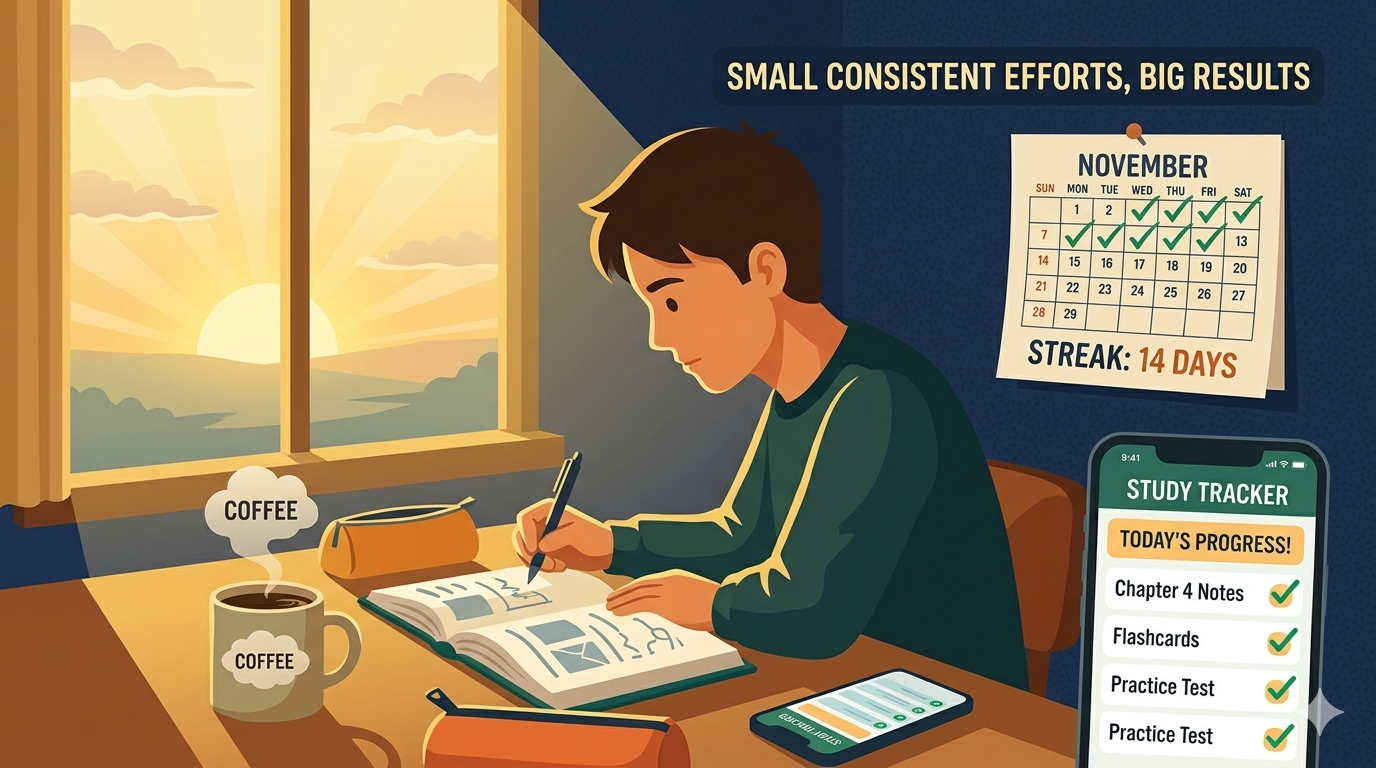
Use any habit tracker — an app, a wall calendar with X marks, or a simple spreadsheet. The visual chain of completed days creates its own motivation.
2. Make Your Phone Work for You
Your phone is either your biggest distraction or your best study tool. Set it up:
- Install your exam prep app (scenario questions during commute or waiting rooms)
- Set a daily reminder at your chosen study time
- Put social media apps in a folder on the second screen — and your study app on the home screen
3. Plan for Bad Days
You will have days where studying feels impossible. Plan for them:
- Minimum viable session: On the worst days, do just 10 minutes. Open the app, answer 5 questions, close it. The streak stays alive, and you often end up doing more once you start.
- Weekly buffer: If you miss a weekday, Saturday’s longer session absorbs it. Don’t feel guilty; use the system.
- Forgiveness rule: Miss two days in a row? Don’t try to “make up” the lost time. Just resume tomorrow at 30 minutes. Catching up creates pressure; resuming creates momentum.
The Compound Effect
Here’s the math that should motivate you:
- 30 minutes × 5 days = 2.5 hours/week
- 2.5 hours × 8 weeks = 20 hours of focused study
- 20 hours of active, scenario-based practice ≈ 40+ hours of passive reading
Twenty hours doesn’t sound like much. But twenty hours of deliberate, tracked, active practice is how most successful candidates pass their certification exams — while working full-time.
The secret isn’t studying more. It’s studying consistently.
Above Target apps are designed for professionals who study in short sessions. Scenario-based questions you can practice in 5 minutes — on the train, during lunch, before bed. Start free →