
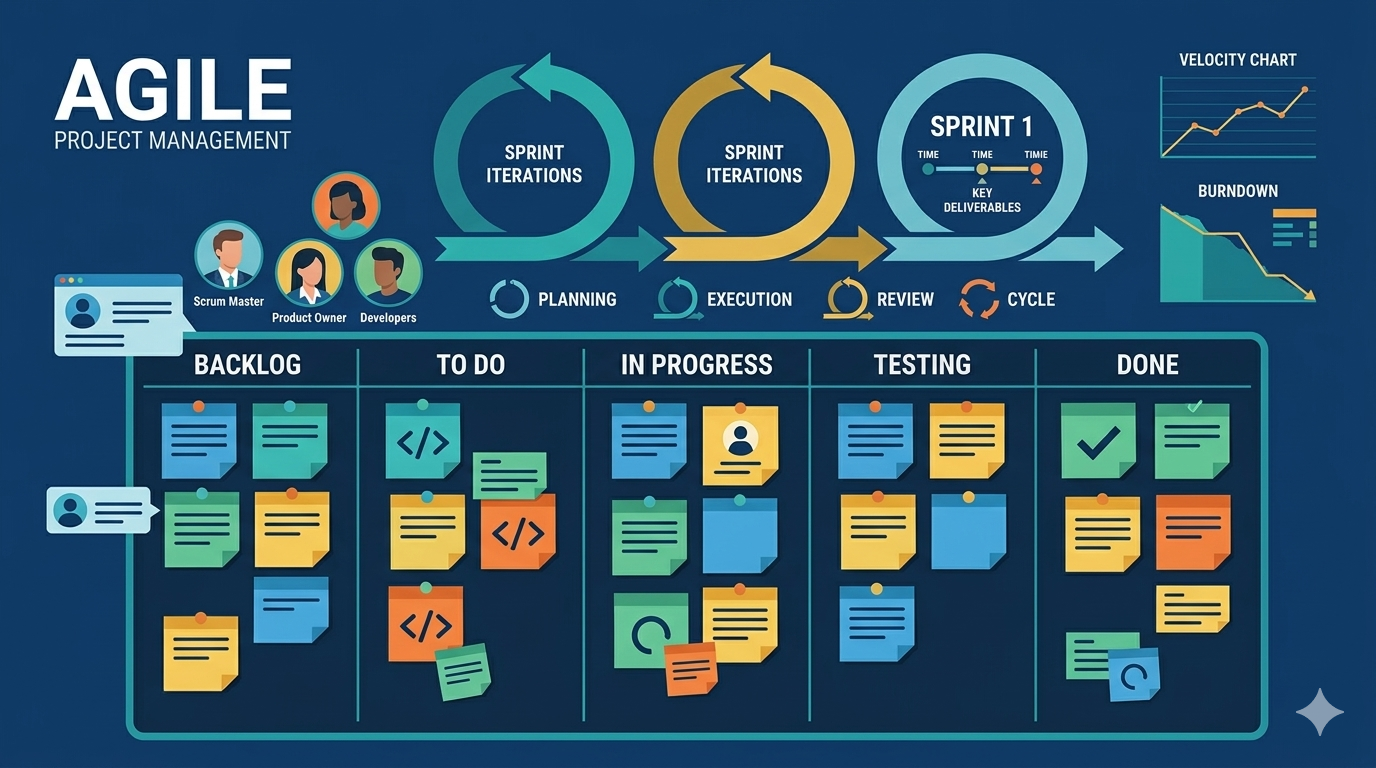
It’s Not Agile vs. Waterfall
Here’s the first thing most PMI-ACP candidates get wrong: they think the exam is about proving Agile is better than Waterfall.
It’s not.
The PMI-ACP exam tests whether you understand when and why to apply Agile practices. That means knowing the principles deeply enough to recognize which approach fits a given situation — and sometimes the answer is a hybrid approach, or even a predictive one.
The Mindset Shift That Changes Everything
Most study guides drill you on Agile frameworks: Scrum ceremonies, Kanban WIP limits, XP practices. That knowledge matters, but it’s table stakes.
What separates candidates who pass from those who don’t is contextual judgment:
- When should you timebox vs. let work flow?
- When does a daily standup help vs. create overhead?
- When should you push back on a stakeholder vs. adapt to their feedback?
The exam puts you in messy, real-world situations and asks: “What would an experienced Agile practitioner do here?”
The Three Knowledge Layers
Think of PMI-ACP preparation as building three layers:
Layer 1: Framework Mechanics
This is where most candidates spend 80% of their time — and it should be about 30%.
- Scrum roles, events, and artifacts
- Kanban principles and flow metrics
- XP practices (pair programming, TDD, continuous integration)
- Lean principles and waste identification
You need to know these cold, but knowing them won’t pass you.
Layer 2: Agile Principles and Values
This is the layer most candidates skip — and it’s where the exam lives.
- The Agile Manifesto (all four values, all twelve principles)
- Servant leadership vs. command-and-control
- Empirical process control (transparency, inspection, adaptation)
- Why Agile works, not just how
Layer 3: Situational Application
This is where passing candidates operate:
- A team is struggling with estimation. Do you switch to #NoEstimates, coach them on relative sizing, or bring in historical velocity data?
- A stakeholder demands a detailed Gantt chart. Do you refuse, create a release plan instead, or find a compromise?
- Two team members disagree on a technical approach. Do you decide for them, facilitate a spike, or let them work it out?
There’s no formula. The exam tests your judgment.
Common Traps to Avoid
Trap 1: “Always Choose the Most Agile Answer”
Wrong. Sometimes the best answer involves documentation, upfront planning, or stakeholder management that doesn’t feel “Agile.” The exam values pragmatism over ideology.
Trap 2: Memorizing Tools Without Context
Knowing that a burndown chart tracks remaining work is useless if you can’t identify when a burndown is more appropriate than a cumulative flow diagram.
Trap 3: Ignoring the Human Side
Roughly 30% of the exam covers team dynamics, stakeholder engagement, and communication. If you’re only studying frameworks and metrics, you’re missing a third of the test.
A Better Study Approach
Here’s what actually works for the PMI-ACP:
- Read the Agile Practice Guide (PMI’s official companion) — it’s shorter than you think and directly aligned with the exam
- Study principles before practices — understand the “why” before the “how”
- Practice with scenario questions daily — not just knowledge recall, but situational judgment
- Join an Agile community — hearing how practitioners handle real situations builds the intuition the exam tests
- Review all seven domains equally — don’t over-index on delivery at the expense of stakeholder engagement or team performance
The Real Secret
The PMI-ACP isn’t testing whether you can recite the Scrum Guide. It’s testing whether you’ve internalized Agile thinking deeply enough to apply it when the situation is ambiguous.
Study like a practitioner, not a student. Practice making decisions, not memorizing definitions.
Above Target’s PMI-ACP app puts you in real sprint scenarios where you practice making Agile decisions — the same skill the exam actually tests. Try it free →