
Why do well-prepared candidates still fail?
It is one of the most frustrating experiences in professional development: you put in 6–8 weeks of study, feel reasonably prepared, walk into the exam — and fail. Across PMP (40–50% first-attempt failure rate), PMI-ACP, PSM I, and AWS SAA, the failure pattern is consistent: candidates fail not because they did not study, but because the method was wrong.
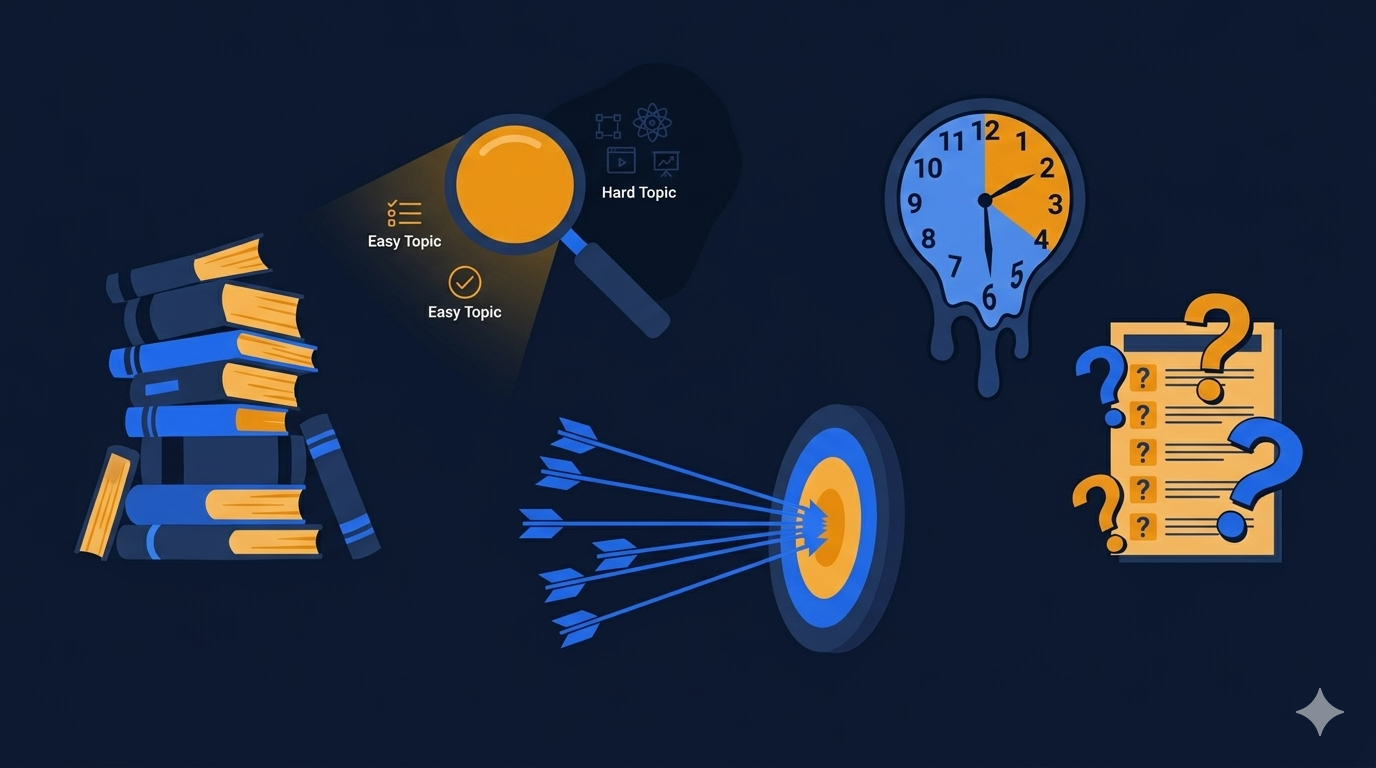
Below are the five mistakes that quietly sabotage even the most disciplined candidates, with the specific fix for each. The pattern is universal — but the cert-specific weights matter, so we map each fix to the major certs at the end.
Mistake 1: Studying to “cover everything”
What happens: You spend 6 weeks watching, reading, highlighting. Mock exam scores hover at 65–70%. You know the words but cannot pick the right answer when two options both look reasonable.
The fix — prioritise high-weight domains: for PMP, that is People (42%) and Process (50%) today, shifting toward Business Environment (26%) after July 2026. For PMI-ACP, Agile Principles + Delivery dominate. Spend 70% of your time on the domains that account for 70% of the exam, and accept that you will not memorise every footnote.
For the full PMP weight breakdown including the July 2026 update, see the PMP Certification Guide 2026.
Mistake 2: Avoiding your weak areas
What happens: Your practice scores plateau because you are perfecting your strengths while leaving 30% of the exam under-prepared. PMI Study Hall and similar simulators flag this clearly with per-domain scoring.
The fix — track accuracy by domain after every practice session. Force yourself to spend the next session on your lowest-scoring domain. Discomfort is the signal that you are learning. The candidates who pass first attempt are the ones who turn their weakest domain into their second-strongest by exam day.
Mistake 3: Binge studying in the final week
What happens: You retain material from the first 2 hours of each cram day and waste the rest. By exam day, you are mentally tired before you sit down — and the PMP is a 4-hour mental marathon, the PMI-ACP is 3 hours, AWS SAA is just over 2.
The fix — study in 30–45 minute focused blocks, spread over 6–8 weeks. Your brain consolidates information during rest. Short consistent sessions beat long desperate ones every time. For PMP specifically, plan to sit the exam within 30 days of finishing your 35-hour training; beyond that, retention drops fast.
For habit pacing alongside a full-time job, see How to build a study habit that sticks with a full-time job.
Mistake 4: Using only one type of practice
What happens: You recognise concepts on the exam but cannot apply them. The question describes a scenario, you know the framework, but you cannot decide what to do — because you have never practised deciding.
The fix — mix three types of practice in every session:
- Recall — close the book and write down what you remember about a topic.
- Application — answer scenario-based questions where you must make decisions.
- Teaching — explain a concept to someone (or to yourself out loud).
If your study session does not include at least one active mode, you are consuming, not learning. The third mode (teaching) is the most-skipped and the most powerful.
Mistake 5: Ignoring the exam’s question style
What happens: You study the content but not the format. Question structure throws you off. You spend too long parsing prompts, second-guess yourself, and run out of time. The July 2026 PMP update makes this worse by adding multi-question case studies and drag-and-drop tasks — totally new formats for anyone who studied with pre-2026 material.
The fix — get at least 200 practice questions that match the exam’s actual format. Not just topic quizzes, but full scenario questions with the same length and complexity. Take at least two timed full-length mocks before your test date. PMI Study Hall for PMP, Scrum.org’s free open assessments for PSM I, and AWS Skill Builder for SAA are the format-true sources.
How the five mistakes map to the major certs
| Cert | Highest-leverage fix | Format-specific risk |
|---|---|---|
| PMP | #5 — practise the PMP Mindset on full-length mocks | Multi-question case studies + drag-and-drop after Jul 2026 |
| PMI-ACP | #1 — concentrate on Agile Principles + Delivery | Scenario-based judgement, not framework recall |
| PSM I | #4 — recall + teaching for Scrum Guide rules | 60-minute timer; speed under pressure |
| AWS SAA-C03 | #2 — drill weakest service category daily | Trade-off questions: 2 valid answers, 1 best for the constraint |
The pattern behind all five
Every mistake involves passive study replacing active practice. Reading about project management does not make you a project manager. Reading about Agile does not give you Agile instincts. The exam knows this — which is why modern certification exams across PMI, Scrum.org, and AWS are scenario-based.
The candidates who pass on first attempt study actively: making decisions, tracking weaknesses, and practising under realistic conditions. For PMP-specific failure modes and the 2026 angle, see Why most PMP candidates fail — and how to pass.
Pre-exam checklist
Before you book your exam date, you should be able to answer “yes” to all five:
- I know which domains carry the most weight and I have prioritised them.
- I have identified my three weakest topics and spent extra time on them.
- I have been studying in short sessions over multiple weeks (not cramming).
- I have practised with scenario-based questions, not just knowledge recall.
- I have taken at least one full-length timed practice exam.
If any answer is “no”, you are not ready yet — and that is fine. Better to delay a week than to retake in 60 days.
Above Target apps are built around active, scenario-based learning aligned to the modern exam formats. Explore the apps →.